
Salespeople Are Like Doctors: Why Diagnostic Selling Wins

Hello, market player.
You’ve surely experienced how salespeople try to give customers as much information as possible. They talk about product features, benefits, and possibilities. They explain how valuable it is and how it will solve the customer’s problems.
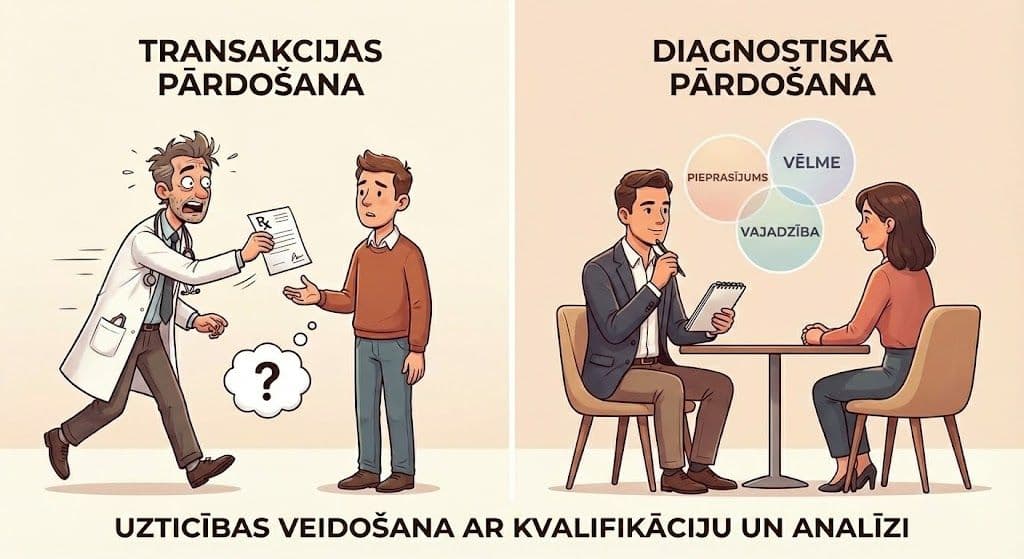
Now imagine going to a doctor. Something hurts, but before you manage to say a single word, the doctor has already begun writing a prescription.
He asks nothing. Shows no interest in your symptoms. He simply hands you the prescription and says: “These medicines are excellent! Everyone uses them!”
Would you trust him? Hardly.
You would definitely think he’s crazy and try to get out of there as quickly as possible.
It’s exactly the same with salespeople. If a salesperson assumes at the very beginning of the conversation that his product is exactly what the customer is looking for and immediately starts “treating,” the customer instinctively pulls back. He senses that the salesperson does not understand his situation and is not making any effort to understand his needs.
A good salesperson is not just a talker. He is a diagnostics specialist.
His task is not to change the customer’s thinking, but to understand whether his offer is even appropriate for the customer.
Great salespeople don’t talk more — they ask more questions.
How does this work in practice?
To successfully close a deal, both sides must understand one thing: whether there is truly a match between the customer’s needs and the salesperson’s offer. If not, the deal will not happen. And that is exactly how it should be.
Because a good salesperson does not sell just for the sake of selling. He sells if and only if his product truly fits the customer.
There are three main factors in sales that determine the outcome of a deal. You can be a great speaker, but if these factors are not in your favor, the sale will not happen.
Demand – Does the customer even have the means and ability to purchase your offer? If he does not have the financial capacity, he will never buy. It doesn’t matter how good the product is.
Desire – Does the customer genuinely want a high-quality solution? Many people complain about their problems, but only a few truly want to solve them.
Need – Does the customer recognize that he even needs a solution? Many people live with problems they consider normal. They don’t even realize something better is possible. Your task is not just to offer a product. Your task is to determine whether he clearly understands that he has this problem and that it is worth solving.
If at least one of these points falls through, then the product and the customer are not the right match. And a good salesperson recognizes this. He does not try to persuade, but evaluates whether the deal is mutually beneficial.
Let me emphasize again… Your role is not just to sell. Your role is to diagnose.
Just as a doctor first asks questions and performs examinations before prescribing treatment, a salesperson begins by understanding the customer’s situation. If he sees that the solution is not suitable, he openly says so.
Because selling an unsuitable product does not gain a customer — it destroys your reputation.
What to do next?
Next time you speak with a customer, ask yourself: “Do I truly understand his situation?” If you are not sure, ask more questions.
Find the reason why the customer is interested in the first place. And only when you know that your offer truly fits should you begin talking (or better — asking) about the solution.
If you implement this in your sales approach, you will not only close more deals but also gain more loyal customers who will trust you.
Respectfully,
Gatis Silakaktiņš
Riga Chamber of Commerce
Chairman of the Board
P.S.
If you want to sell with confidence and precise, strategic understanding, B2B Academy is the place to learn it. Work with proven methods and train alongside industry professionals.
👉 Learn more here: >>> B2B Academy <<<